History of Tattoos: Origins, Traditions & Culture
Tattooing is older than writing. The urge to mark the skin in permanent ways predates most of what we consider civilisation, and it appears in every corner of the human world — independently developed across cultures that had no contact with one another, which suggests something fundamental about the human relationship with the body and the desire to mark it. Understanding where tattooing comes from doesn't just make for good conversation — it deepens the significance of a practice that many people still dismiss as a recent fashion trend. It isn't. It's one of the oldest things humans do.
The Earliest Evidence: Ötzi and Ancient Egypt
The oldest confirmed human tattoos belong to Ötzi the Iceman, a naturally mummified man discovered in 1991 in the Alpine ice on the border of Austria and Italy. Ötzi died approximately 5,300 years ago. He has 61 tattoos — groups of short parallel lines, mostly on his lower back, knees, and ankles. Analysis of the placement suggests they were therapeutic rather than decorative: they align with acupuncture points used in Chinese traditional medicine, and the joints they mark show signs of arthritic wear. Ötzi's tattoos may represent the earliest evidence of tattooing as medical practice.
Ancient Egyptian mummies, including female mummies dating to around 2000 BCE, show tattoo patterns on their abdomens, thighs, and breasts — generally interpreted as protective symbols associated with fertility and childbirth. A mummy discovered at Deir el-Medina in 2016, a female roughly 3,500 years old, had 30 tattoos including wadjet eyes, lotus plants, and seated baboons — clearly symbolic, complex, and deliberately placed. Egyptian tattooing appears to have been primarily a female practice, connected to religious and protective functions.
Pacific Island Traditions: The Living Heritage
While tattooing existed across the ancient world, the Pacific Islands produced what are arguably the world's most sophisticated and socially embedded tattoo traditions — ones that remain living practices today. Polynesian tattooing encompasses distinct traditions across Hawaii, Samoa, Tonga, the Cook Islands, and New Zealand, each with its own visual language and social function.
In Samoa, the pe'a — a traditional male tattoo covering the body from waist to knee — is one of the most demanding tattooing experiences in the world, applied over multiple painful sessions using a traditional comb tool made of bone or tusk. It marks the completion of adolescence and carries community significance that goes far beyond aesthetics. In Maori culture, ta moko — facial and body tattooing using chisels rather than needles — encoded genealogy, rank, and personal history directly onto the body. Every element of a traditional ta moko is referential: it is biography and identity written in skin.
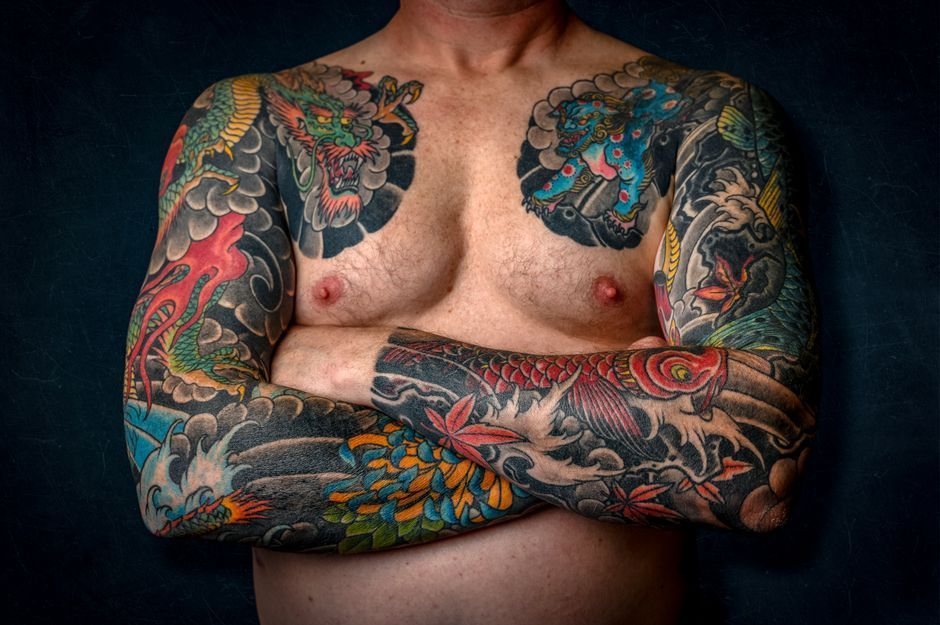
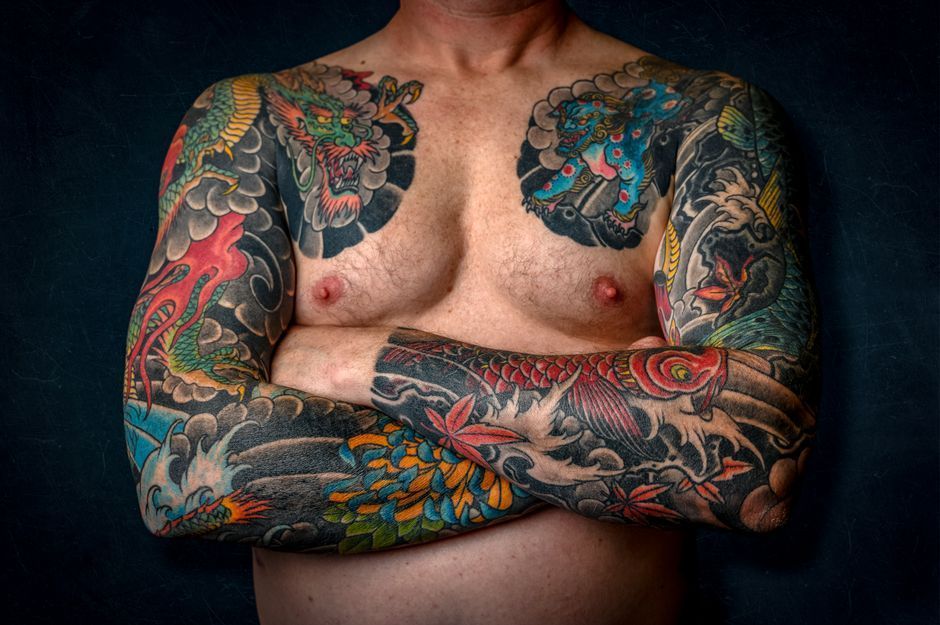
Japanese tattooing (Irezumi) developed its own sophisticated tradition from approximately the Edo period (1603–1868), evolving from criminal marking into an elaborate art form associated with the working class and the yakuza. The visual language of Irezumi — koi fish, dragons, cherry blossoms, oni masks, waves — developed into a complete symbolic system that remains the foundation for traditional Japanese tattooing practised globally today.
The Western Encounter: Captain Cook's Voyages
Before the late 18th century, tattooing was largely absent from mainstream Western European culture. The crucial encounter came with the voyages of Captain James Cook — particularly his first voyage to the Pacific (1768–1771), during which Cook and his crew encountered Polynesian tattooing in Tahiti and New Zealand. Cook's naturalist Joseph Banks returned to Britain with detailed descriptions of the practice, and Cook's sailors returned with tattoos on their bodies.
The word "tattoo" itself entered the English language from this encounter — derived from the Tahitian word tatau. Within decades, the practice spread among sailors and working-class men across Britain, Europe, and North America. The sailor tattoo tradition — anchors, swallows, ships, mermaids, and the famous "hold fast" knuckle tattoos — developed its own dense symbolic language: a swallow represented 5,000 miles sailed; a fully rigged ship meant a voyage around Cape Horn; a fully tattooed body was the mark of a man who had spent a life at sea.
The 20th Century and Counter-Culture
Through the early 20th century, Western tattooing remained primarily associated with sailors, soldiers, circus performers, and the working class. Samuel O'Reilly's invention of the electric tattoo machine in New York in 1891 transformed the craft technically — making it faster, more consistent, and accessible to a wider population — but the social associations of tattooing kept it outside mainstream respectability.
The mid-20th century saw tattooing become associated with motorcycle culture and criminal underworlds, which reinforced its outsider status. In Japan, association between Irezumi and the yakuza led to tattooing being banned in public bathhouses and gyms — a restriction that persists in many establishments today. But the counter-culture movements of the 1960s and 70s reframed tattooing as a mark of intentional non-conformity rather than criminal association, and the seeds of the modern tattoo renaissance were planted.
The Custom Art Revolution of the 1980s and 90s
The transformative period in modern Western tattooing came in the 1980s, driven by a generation of artists — Don Ed Hardy, Sailor Jerry, Lyle Tuttle — who insisted on treating tattooing as fine art rather than craft service. Hardy in particular brought Japanese art school training to tattooing, producing works of genuine compositional and technical sophistication that challenged the idea of tattooing as a low-culture practice. His work directly influenced a generation of artists who expanded what tattooing could look like.
By the 1990s, tattooing had entered mainstream Western culture decisively. The decade saw tattooing spread across class and gender boundaries in a way that hadn't happened before: women in significant numbers, middle-class clients, custom art commissions rather than flash-off-the-wall copies. The groundwork was being laid for what would become a genuine art form renaissance.
Contemporary Tattooing: Where We Are Now
The past fifteen years have seen tattooing reach a genuine cultural integration that would have been unimaginable fifty years ago. Fine line tattooing — made possible by advances in needle technology and machine precision — has produced a generation of artists capable of botanical illustration, portraiture, and abstract design at a level of detail that challenges what seems possible on skin. Social media, particularly Instagram, has globalised the exposure of individual artists' work in ways that entirely changed how clients find and choose artists.
The UK tattoo industry is now one of the most technically accomplished in the world, producing internationally recognised artists working across every style. And perhaps most significantly, the demographic of tattooed people has shifted completely — the majority of people under 40 in the UK have at least one tattoo, and the practice carries none of the social stigma it held as recently as twenty years ago. What was counter-culture has become, if not mainstream, at least unremarkable — while the quality of the art being produced is arguably higher than at any point in history.
Frequently Asked Questions
When did tattooing become socially acceptable in the UK?
It's been a gradual shift rather than a clear moment. The 1990s brought tattooing into mainstream youth culture; the 2000s saw it spread across age groups; by the 2010s, visible tattoos in professional settings had largely lost their previous career-limiting associations in most fields. It's still context-dependent, but social acceptance of tattooing is now the rule rather than the exception in the UK.
Are there cultures where tattooing was never practised?
Tattooing appears to have developed independently in dozens of cultures across every inhabited continent. The notable absence is Sub-Saharan Africa, where darker skin tones made tattooing less visible and scarification developed as the more common form of permanent body marking instead. Even here, there are exceptions in specific groups.
What's the most significant technical development in the history of tattooing?
Samuel O'Reilly's electric tattoo machine (1891) was probably the most transformative single invention — it made consistent, controlled, faster tattooing possible at a scale that the hand-tapping method couldn't achieve. More recently, precision rotary machines and specialised single-needle configurations have enabled the fine line work that defines much of contemporary tattooing.
How has the internet changed tattooing?
Radically. Before Instagram, artists' work was visible only to people who walked into their studio or saw their print ads. Social media allowed clients to find artists anywhere in the world, created global style trends, and forced artists to compete on the quality of their work in an entirely new way. It also democratised access to information about aftercare and healing, raising the standard of how clients look after new tattoos.
History is a foundation, but the work we're producing today is what matters now. See our tattoo portfolio or book a consultation to start talking about your next piece.